
Welcome offer: 10% off on your first order with code "SVAMART10" X
Stories & Prospectives

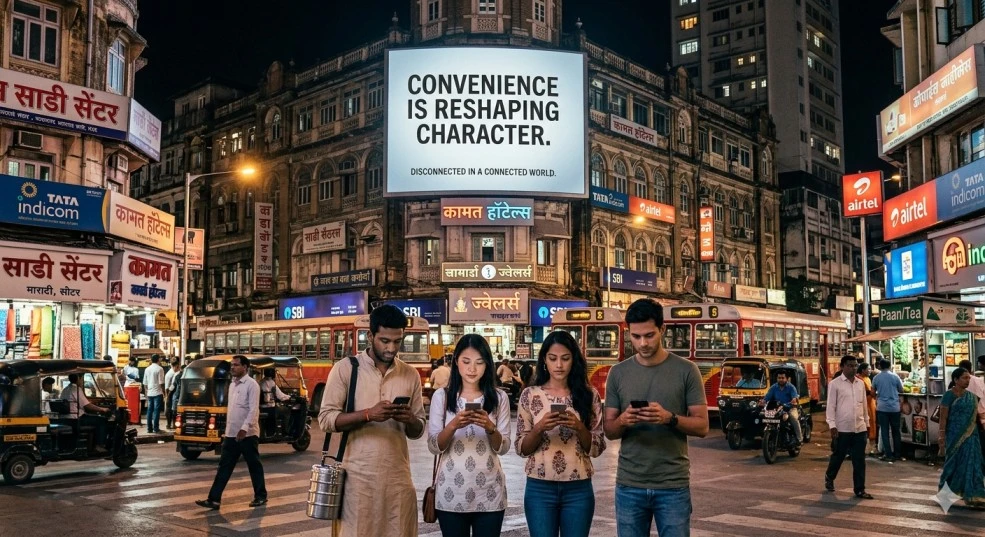
Convenience Is Reshaping Character

By Roshan Yaduvanshi 4 Views Mar 24, 2026
Convenience Is Reshaping Character

Ease, Speed and the Quiet Reshaping of Human Value

Convenience is often celebrated as one of the clearest signs of progress. Faster delivery, instant access, ready-made solutions and seamless digital systems have made modern life more efficient than ever before. In practical terms, convenience saves time, reduces friction and simplifies everyday decisionsnBut convenience does more than improve systems. It also influences human behaviour.

“Every system that removes effort also changes our relationship with value.”

When Ease Becomes Normal

When speed becomes normal, waiting begins to feel unnecessary. What earlier generations accepted as part of process is now often experienced as delay. Patience, once a daily practice, slowly becomes a diminishing skill. This shift is not only cultural. It is psychological. Human beings adapt quickly to comfort. What begins as a luxury soon becomes an expectation. Once instant access becomes familiar, anything slower appears inefficient. Over time, the mind stops seeing ease as a benefit and starts treating it as a baseline. This changes how we judge products, services and even people. If everything is supposed to arrive quickly, then anything that takes time begins to look flawed. “Convenience is invisible at the point of use, but never at the point of production.”

The Disappearing Process

This is where the deeper tension begins. Smooth consumer experiences often hide complex systems of labour, logistics, extraction and coordination. A product that arrives in one day may have passed through long chains of planning, packaging, warehousing and transport. A digital service that feels instant may depend on invisible technical and human infrastructure. Yet the consumer sees only the final ease. When process disappears from view, appreciation often weakens. People become less aware of the effort behind outcomes. The result is a subtle change in perception: labour becomes ordinary, speed becomes expected and time-intensive work begins to seem expensive.

Speed and the Market

This has broad economic consequences. Convenience increases consumption because it reduces reflection. The easier it becomes to access something, the less mental resistance stands between desire and purchase. Ease encourages repetition. Frictionless systems accelerate frequency. In such environments, value is often redefined around availability, affordability and speed “Ease expands markets, but it can also narrow perception.” A handmade object may then feel slow. A thoughtful service may seem inefficient. A careful process may appear commercially weak. The problem is not that convenience exists. The problem is that convenience becomes the dominant lens through which everything is judged.

The Human Shift

This affects character as much as commerce. When daily life trains people to expect immediate results, tolerance for effort begins to decline. Reflection becomes harder. Depth competes with distraction. Care starts losing ground to convenience. This does not mean convenience is inherently harmful. It has improved access, reduced barriers and made many aspects of life easier and more inclusive. Efficiency matters. Time matters.

Beyond Instant Access

But the real question is whether convenience is becoming our only measure of value. “Not everything meaningful is designed for instant access.”

A society that rewards only what is fast may gradually lose sensitivity toward what is careful. And when care becomes secondary, respect for time, labour and process also begins to fade. The hidden cost of convenience is not simply dependence on easy systems. It is the quiet weakening of our ability to honor what still takes time.

Share Now

Download application to explore more

Bringing art into lifestyle